Dorabaltea is an innovative company in the market that studies and designs new solutions primarily aimed at transforming waste water into a clean resource to be reused. Especially due to the drought emergency, the lack of water is becoming a persistent problem that must be absolutely resolved. Water is indeed a vital source, and without it, there is no life. Dorabaltea starts from a concept as simple as it is innovative: if water is lacking, then we must reuse what already exists. Thus, the recovery of wastewater becomes the starting point for the company, capable of making it perfectly reusable for irrigation. How is all this possible? Legitimately, users wonder how it is possible to treat wastewater to then reuse it. In the market, there is a perception that all this is impossible unless a significant economic investment is made. Dorabaltea, however, “overturns” established ideas and turns this concept on its head: the reuse of wastewater is not only possible, but this result can also be achieved with a very modest, prudent, and accessible investment for everyone. To these advantages, we must also add tax incentives, which are significantly encouraging the installation of eco-friendly devices, further reducing initial costs. Customers who intend to install wastewater treatment plants can benefit from the 50% Renovation Bonus, a tax relief for those completing construction work, which includes the solutions proposed by Dorabaltea. The Bonus indeed provides for a 50% deduction on the expenses incurred for the installation of a wastewater treatment plant. In practice, the expenses incurred for the device can be deducted from the taxes paid by the citizen through annual installments of the same amount for 10 years. Dorabaltea in recent years has already “produced” numerous products that have revolutionized the market, and now it has launched a new product that represents the new frontier of wastewater treatment: Atlas Plus Oval R. This is an absolutely innovative technology for the Italian and European market, thus it has virtually no rivals. The demand in the construction sector is heading in one direction, which indeed foresees the reuse of wastewater. The latest gem from Dorabaltea thus meets market demands, aiming to reuse water economically, cleanly, and sustainably. In the following paragraphs, we will analyze better how Atlas Plus Oval R works, outlining the general lines of the market but generally of the global situation regarding drought and water scarcity.
Drought, a problem destined to last for many more years
In recent years, Italy, but in general the entire planet, has been dealing with abnormal heat and a reduction in precipitation that creates economic damage to agriculture and, in the future perspective, to the supply of drinking water. To have a broader picture of the situation, it is enough to know that from December 2021 to the end of February 2022, Italy received 80% less rain and 60% less snow compared to the seasonal average, and the situation this year has not improved at all; on the contrary, it has worsened. To all this, we must add extraordinarily warm winters, especially in the North, where several rivers and lakes are dry. The drought has thus become a real calamity for farmers, and its absence negatively impacts livestock and agriculture. Fewer products are obtained, which are sold on the market at a higher price. It is no longer just an economic problem, but even a vital one. The reuse of wastewater/recycling of water is therefore not a possibility, but a necessity. Thinking in this perspective, Dorabaltea, utilizing qualified and trained technicians and innovative and sustainable instruments, has perfected a system accessible to all that allows for the purification of wastewater for irrigation, significantly reducing the impact on the surrounding environment.
The treatment of wastewater
To better understand the functionalities and benefits offered by Atlas Plus Oval R, it is appropriate to know the process of wastewater treatment and how important it has become in light of the critical issues arising from drought. Business activities, whether recreational or productive, require a large amount of water. The water used during the process becomes contaminated, producing discharges that, before they can be redistributed into the environment, must undergo a thorough treatment process. Urban wastewater until some time ago contained almost exclusively biodegradable substances, but today this is no longer the case. Their disposal is decidedly more complicated due to the presence of synthetic chemical compounds, used mainly in the industrial sector. All this harms lakes, rivers, and seas that receive a quantity of pollutants exceeding their self-purification capacity, thus compromising their waters and disrupting the normal balances of the ecosystem. This is why the treatment of wastewater through treatment systems capable of mimicking natural biological processes assumes crucial importance.
What does the legislation say?
The treatment of wastewater is regulated by the Italian legislation with D.Lgs. April 3, 2006, n. 152. The decree also implements the EU directive 91/271/EEC regarding the treatment of urban wastewater, which represents the reference standard for all EU member states. First of all, the decree regulates discharges, maintaining the limit values of concentration for the various substances present in wastewater. Furthermore, it focuses on the quality of the receiving water body itself, providing for careful monitoring activities to quantify the environmental damage caused by humans and indicating the bases on which to base the search for treatment systems. With the entry into force of the D.M. of September 18, 2022, n. 198 “Implementation methods on the state of water quality, pursuant to art. 3, paragraph 7, of D.Lgs. May 11, 1999, n. 152”, it is expected that all knowledge data, information, and reports on the state of water quality are sent to APAT by the Regions and Autonomous Provinces within the deadlines set by the decree. In this way, it is possible to collect all the data and information necessary to adopt the best countermeasures.
The basic processes of wastewater treatment
Treatment occurs through advanced technologies that, however, primarily exploit and rely on natural phenomena, precisely to ensure a final product that is 100% naturally purified. In biological treatment, living organisms and the action of different microbial populations, both in natural environments (such as self-purification) and artificial (such as treatment plants), promote the degradation of pollutants present in the water through mineralization processes and collection in a semi-solid material, the sludge, which is subsequently separated from the water by sedimentation. The microorganisms involved in the treatment process consist of bacteria and a varied microfauna, partly already present in the wastewater and partly coming from the surrounding environment. This biological community, thanks to Dorabaltea technologies, develops and grows thanks to the organic matter present in the wastewater that needs to be treated. This creates a true food chain of detritus.
Final objective of treatment: the final reuse of water
The reuse of wastewater is clearly aimed at reducing water waste for the benefit of the surrounding environment, but all processes must be completed according to the application of specific technological knowledge to achieve socially and economically useful objectives, such as the correct use of a precious resource like water, the protection of surface water bodies, and underground aquifers. In the modern perspective, the reuse of wastewater should therefore be understood as an alternative process to optimize the water resource, which is becoming increasingly precious and unfortunately increasingly scarce. Not by chance is water also known as blue gold, and the correct reuse of water translates into an economic advantage for the entire community that cannot do without water supply. An important step is represented by the Decree of June 12, 2003, n. 185 “Regulation containing technical standards for the reuse of wastewater in implementation of article 26, paragraph 2, of legislative decree May 11, 1999, n. 152”, which regulates the treatment and distribution of wastewater to promote its recovery and reuse in urban and industrial contexts. This decree establishes precise technical standards for the correct reuse of domestic, urban, and industrial wastewater with clear regulations regarding the intended use of water to qualitatively and quantitatively protect water resources. The objective of the decree is:
- limit the withdrawal of surface and groundwater;
- reduce the impact of discharges on receiving water bodies;
- promote water savings through the reuse of wastewater.
Here are the possible applications of wastewater:
- irrigation for agriculture;
- street washing in civil contexts;
- feeding heating and cooling systems and for feeding dual supply networks;
- availability of fire-fighting water and for washing thermal cycles in industrial contexts.
To reuse water for any of these applications, it is necessary to achieve a certain degree of quality, especially from a hygiene and health perspective. Therefore, traditional conventional treatments such as Imhoff tanks or biological tanks are not sufficient; thus, technology is increasingly specializing to produce alternative secondary, tertiary treatment, and disinfection systems to achieve an optimal water quality level by reducing microbial load, nutrients, and toxic substances. Among the latest generation technologies is Atlas Plus Oval R, which guarantees a greater supply of treated water at contained costs.
Advantages of reusing treated wastewater compared to rainwater
One might argue that to address the drought emergency, it is enough to exploit rainwater, the use of which is made mandatory by many local regulations, especially for new constructions or renovations. However, there are some observations to be made, which we have partly anticipated when we mentioned the long-standing problem of drought. Rainwater is only available when it rains, so there is a risk that it may not be present precisely when needed. More than a risk, it is a concrete criticality, and indeed it has often happened in recent years that rainwater was not available when it was needed. This happens because summers are becoming increasingly arid and less rainy, but now little rain is seen even in mid-winter. On the contrary, wastewater is produced every day, as it comes from toilets, showers, kitchens, laundries, and generally from all daily activities. To better understand the differences between the use of rainwater and wastewater, let’s do a small calculation. Let’s take as a reference a 300 square meter garden that on average needs 900 liters of water every day. All the water accumulated in winter, especially if it doesn’t rain in summer, might be enough for 10-15 days. The purchase of a rainwater accumulator would therefore turn out to be an unnecessary cost and not a profitable investment. If it doesn’t rain, the same rainwater accumulator has no reason to exist because it has nothing to accumulate. And, above all, there is no water available to irrigate a garden. Now let’s consider a family of 5 people who, on average, discharges 1,000 liters of water a day. That same water, once treated, can be easily reused for irrigation. The storage tank of the Dorabaltea system is filled and emptied every day, ensuring a constant availability of clean water. Thus, treating wastewater makes sense, as the necessary water is produced at home without additional costs. Except for the initial expense, the only costs to be incurred are those of electricity, which amount to less than 100 euros per year. It should also be noted that with the 50% Renovation Bonus, it is possible to recover 50% of the incurred expenses, with a 50% deduction spread over 10 equal annual installments. There is also another important consideration that tips the balance in favor of wastewater. Rainwater contains nitrogen, but domestic wastewater, in addition to the same nitrogen, is also rich in carbon and phosphorus. What does this mean? That treated wastewater, in addition to irrigating, also serves as fertilizer for the garden and plants. Water savings are accompanied by significant savings on fertilizer purchases, benefiting both the planet and the user’s wallet.
A house with Atlas Oval Plus R gains greater commercial value
Atlas Oval Plus R not only treats wastewater, providing significant economic and ecological benefits, but also tangibly increases the commercial value of the property. Let’s compare two houses located in the same area and with the same characteristics, but with some differences. One is equipped with photovoltaic panels for electricity production, solar panels for hot water production, a storage tank for water reuse, and generates heat through biomass instead of gas, while the other house does not. Well, the first house not only sells more easily but also at a higher price. In practice, installing Atlas Oval Plus R represents a future-oriented investment as the real estate value of the house is increased, which can potentially be sold at a higher cost.
How is Atlas Oval Plus R constructed?
At this point, let’s analyze the structure of Atlas Oval Plus R, which is, in fact, an evolution of the already existing Atlas Plus.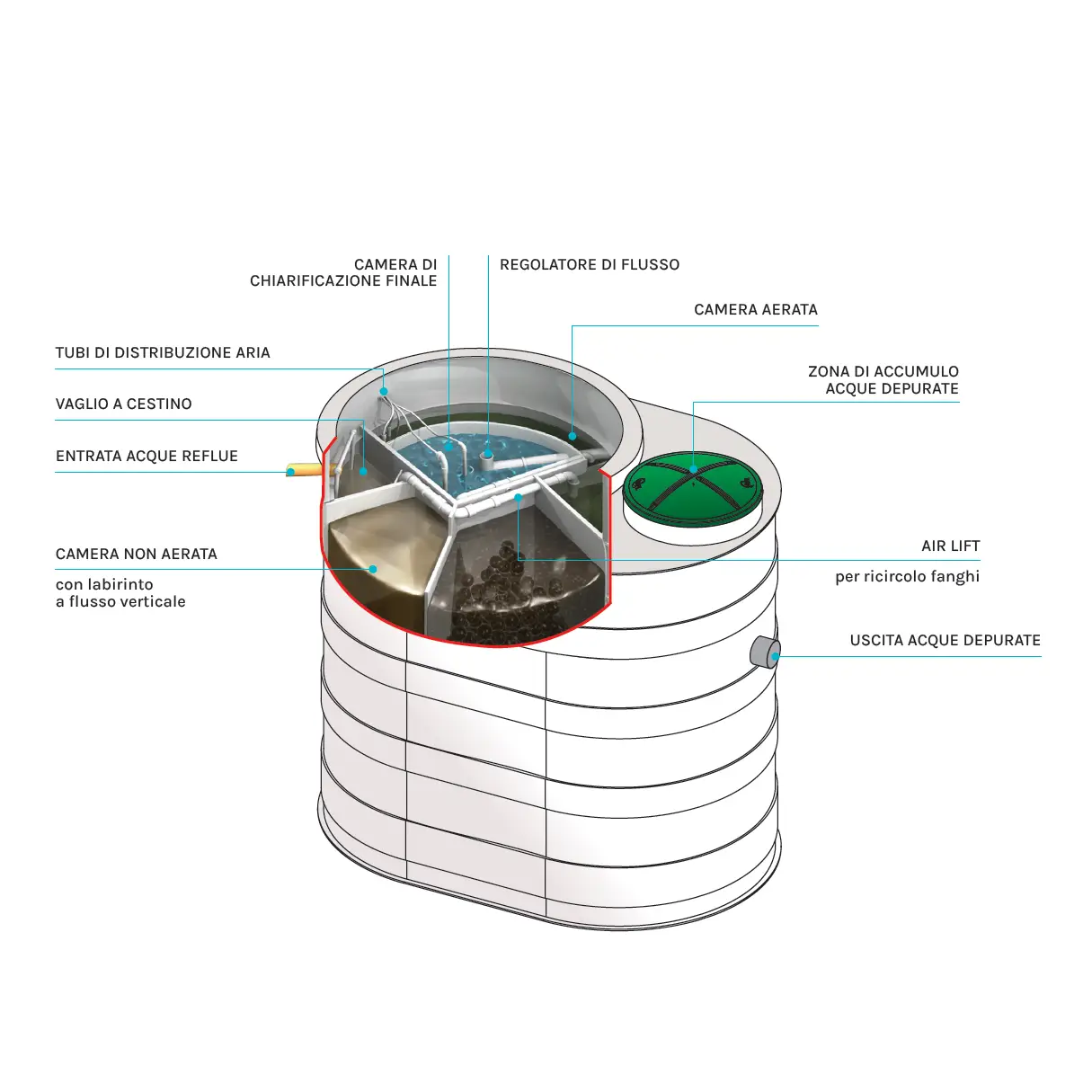 In the previous device, dirty water entered through a pipe and, through various phases, completed the entire process to then exit through another pipe arriving in a 50x50 well downstream of the system, where a chlorine tablet was placed to disinfect the water. Downstream of the well, a tank was placed where the water was accumulated for a few hours to allow the water to dechlorinate in contact with air. At that point, it was sufficient to connect a pump to the device to then water the garden directly. In the new solution proposed by Dorabaltea, namely Atlas Oval Plus, all processes occur directly in a single tank where there are:
- the treatment plant;
- the disinfection system;
- the storage tank.
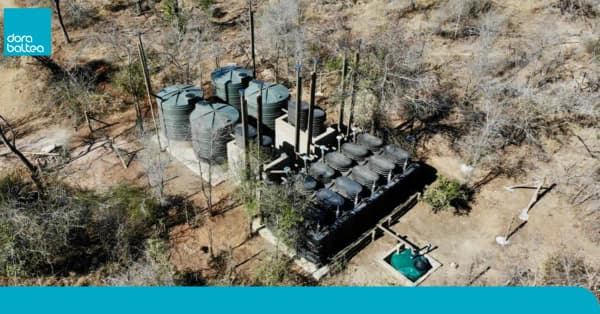
The tank is oval instead of cylindrical, but the main novelty lies precisely in the fact that all treatment processes occur within the device, ensuring countless advantages. The patented AT technology with vertical flow labyrinth is used, an innovative system developed in the European market over the last 15 years that ensures an extraordinary level of efficiency and reliability. The thorough removal of pollutants is guaranteed by the excellent results provided by specific tests required by law according to the CE EN 12566 standard conducted at PIA in Aachen, the most important notified European body that makes the system perfectly compliant with community, national, and regional regulations. The tests according to the EN 12566 standard carried out on the system at the notified body PIA serve to ensure the user who purchases the treatment technology a guaranteed treatment performance, allowing the consumer to purchase the domestic wastewater treatment plant for users below 50 equivalent inhabitants, certain that the treated waters comply with national and local legal limits, as well as having a system in compliance with Italian building and tax regulations. Atlas Oval Plus R is an innovative system for wastewater treatment and water recycling built in a monoblock, while the container and the seven internal components are made of polypropylene. The monoblock system includes the following phases:
- primary treatment performed with labyrinth flow for the sedimentation of coarse materials and the flotation of fats and oils;
- subsequent biological secondary treatment with low-load activated sludge and prolonged aeration;
- final secondary sedimentation treatment.
All this occurs according to an integrated recirculation line that optimizes the residence time of the sludge in the oxidation reactor and reduces the production of sludge itself until stabilizing it at the end of the life cycle. The full efficiency of the treatment process is guaranteed by the integrated retention chamber, even in the presence of load peaks. The outgoing waters are disinfected by means of a chlorinator device and accumulated in a tank integrated with the system. In the end, water is obtained with values that fall within the limits imposed by the Annex 5 of D. Lgs. 152 of 03/04/2006 and can be reused for irrigation purposes. Atlas Oval Plus R: operation and maintenance Let’s analyze more specifically the innovative operation of Atlas Oval Plus R that releases perfectly treated water to be reused for irrigation. The wastewater arrives from the discharge column, enters the treatment plant, and is channeled into the VFL vertical flow labyrinth, which consists of the anaerobic zone of the plant and serves as the primary sedimentation chamber. Under the inlet pipe, corresponding to the first chamber of the labyrinth, there is a small manual basket that prevents coarse transported material from proceeding along the path. An internal recirculation mechanism, on the other hand, has the task of sending the sludge deposited in the last chamber of the labyrinth back to the top of it, avoiding any clogging problems upstream. Atlas Oval Plus R has been designed with an adequate volume to ensure such a concentration of activated sludge inside to have sufficient contact times for the bacterial flora to biodegrade the wastewater, achieving output water values that perfectly comply with current regulations. From the labyrinth, the water then passes by gravity to the aerobic zone of the treatment plant, where the fine bubble diffuser distributes air into the integrated retention chamber, where activated sludge flakes subsequently develop that contribute to the degradation of the organic load. From here, still by gravity, the water flows into the final clarification chamber to then exit through the outlet pipe. Inside the aerobic chamber and the final clarification chamber, there is a pipe for the recirculation of sludge, which takes the part that has settled to send it back to the aerobic zone of the labyrinth designated for sedimentation. All phases of sludge recirculation do not involve the use of submerged mechanical parts but exploit the so-called air-lift principle, powered by the same blower responsible for supplying air to the integrated retention chamber where the biodegradation of the organic load then occurs. In this way, the efficiency of the treatment of wastewater produced by users is optimized, so the final outgoing effluent complies with current regulations. The performance of the treatment plant is also guaranteed according to the European Regulation 305/11 (Construction Products Regulation), as it is designed and created by the manufacturing company and verified by a notified testing laboratory according to the EN12566 standard. Within the plant, both black and gray waters can be channeled, either combined or separated. Maintenance requires a few simple steps to preserve and ensure the correct functioning of the device. It is necessary to check that the inlet pipe of the wastewater and the inlet basket screen to the plant are not obstructed by inert material mistakenly discharged from the system. Furthermore, the efficiency of the air redistribution system must be checked, and the plant must be emptied of excess sludge at a frequency appropriate to the use of the device. It is advisable to proceed with partial emptying to leave a sufficient amount of active sludge in the plant to keep the biological process active, every one or two years. During the emptying operations of the primary treatment labyrinth, it is advisable to perform the purging in the two central sectors, thus avoiding damage to the sensitive parts of the recirculation line that go deep to preserve the perfect functioning of the device. Atlas Oval Plus R can be used for the following applications:
- isolated domestic users;
- small communities;
- commercial users and small accommodation activities;
- agri-food and wine activities.
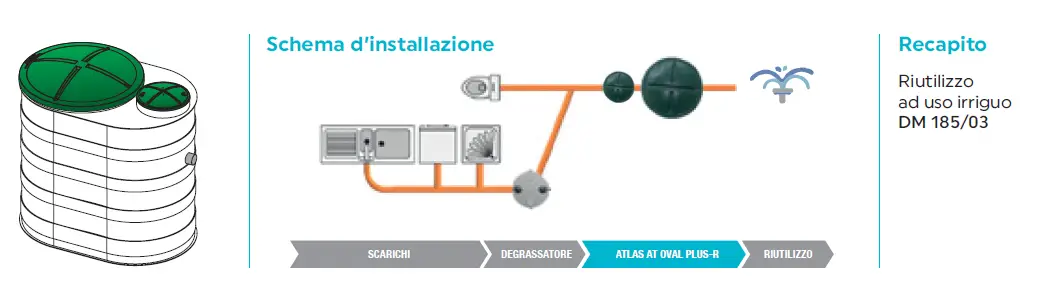 Atlas Oval Plus R compared to a traditional plant To better understand the functionalities and advantages guaranteed by Atlas Oval Plus R, let’s compare it with a traditional wastewater treatment plant. In a traditional plant, there are:
- a biological pit;
- a treatment plant;
- a well;
- a storage tank downstream.
All these components are present within Atlas Oval Plus R but in a single tank. In a traditional plant, the space between one tank and another must not be less than 50 cm, and therefore, making an approximate calculation, more than 6 meters of excavation length for 2 meters of excavation width and about 2 meters of depth is required. The footprint of a traditional wastewater treatment plant is therefore very impactful, and there is a need for very large spaces for the installation of the device. Naturally, costs also tend to increase, as more time is needed for final installation. How does longer installation time translate into higher costs? We explain it right away. The company responsible for the installation of the device needs an excavator to dig the treatment tanks, an operation that takes about 4-5 days under normal conditions. Assuming that the company charges 1,000 euros a day for the use of the excavator, the final cost will be 4,000 or 5,000 euros just for labor, to which are added the costs of materials such as connection pipes, backfill material, disposal of waste materials, and materials for electrical connections. With Atlas Oval Plus R, the timeframes and costs are significantly reduced. The entire installation process takes only one day, as less space is needed, so the cost is only 1,000 euros excluding materials, which are also economically less. Therefore, the installation of a traditional wastewater treatment device costs on average 4,000-5,000 euros, while to install a monoblock Atlas Oval Plus R can save up to 70% of expenses with over 3,000€ in reduced costs.
Calculation of equivalent inhabitants
For optimal reuse of wastewater, it is useful to evaluate, both in production and service activities, the actual production of wastewater to correctly size the treatment systems. The amount of biodegradable organic substances is measured indirectly through the amount of oxygen needed to allow bacteria to modify the biodegradable organic substances present, so as to make them harmless within 5 days. Specifically, the reference value according to the Legislative Decree April 3, 2006 n. 152, “Environmental regulations” is given by the equivalence: 1 (a.e.) equivalent inhabitant = 60 grams of oxygen per day. For a more accurate calculation, the following methods can be followed:
- civil housing counting the beds: 1 a.e. (equivalent inhabitant) for bedrooms with an area up to 14 m2; 2 a.e. (equivalent inhabitant) for rooms larger than 14 m2;
- hotel or accommodation complex: add 1 a.e. when the area of a room increases by 6 m beyond 14 m2;
- factories or craft laboratories: 1 a.e. (equivalent inhabitant) for every 2 employees, permanent or seasonal, during peak activity;
- companies and commercial offices: 1 a.e. (equivalent inhabitant) for every 3 employees, permanent or seasonal, during peak activity;
- restaurants and trattorias: to calculate equivalent inhabitants, it is necessary to quantify the maximum capacity of the dining rooms. For the final calculation, it is useful to know that an average person occupies 1.20 m2. Customers should also be added to the staff. 1 a.e. for every 3 resulting people;
- bars, clubs, and clubs: the calculation is the same as for restaurants and trattorias, but 1 equivalent inhabitant is calculated for every 7 people;
- cinemas, stadiums, and theaters: 1 equivalent inhabitant for every 30 users;
- schools: for every 10 attendees calculated on maximum potential corresponds to 1 a.e.
Alternatively, equivalent inhabitants can be calculated based on the ARPA parameters:
- civil housing: Ab.Eq. (1 for every 35 m2);
- hotels, nursing homes, and similar: Ab.Eq. (1 for every 2 beds);
- restaurants and trattorias: Ab.Eq. (1 for every 5 seats);
- hospital facilities: Ab.Eq. (1 for every 2 beds);
- offices: Ab.Eq. (1 for every 5 employees);
- commercial establishments: Ab.Eq. (1 for every 5 employees);
- industries and laboratories: Ab.Eq. (1 for every 5 employees);
- school buildings: Ab.Eq. (1 for every 5 students);
- museums, theaters, and sports facilities: Ab.Eq. (4 for every WC);
- buildings used for purposes other than those indicated so far: Ab.Eq. (4 for every WC).
The advantages of Atlas Oval Plus R
We have already analyzed some of the main benefits offered by Atlas Oval Plus, but it is worth summarizing to better understand the convenience of this device. Here are the main advantages:
- time savings. As already highlighted throughout the article, Atlas Oval Plus is a device that installs quickly and significantly reduces wastewater treatment times;
- space savings. Unlike traditional plants, which require a very deep pit for installation, Atlas Oval Plus R requires significantly less space. In homes with little space available, it can be problematic, if not impossible, to install traditional plants that need at least 6 meters for all tanks. Atlas Oval Plus R, on the other hand, can be installed even in those houses with little space available;
- money savings. In addition to saving time and space, it is also worth mentioning economic savings. The installation and maintenance of the system require very low costs, making the device accessible to all budgets. In any case, the investment is still recovered and amortized over time, as there is no need to spend money on water supply since water is produced directly at home without additional costs;
- 50% tax savings. Thanks to the 50% Renovation Bonus, it is possible to deduct the expenses incurred for the purchase of the treatment plant by 50%. The deduction is spread over 10 equal annual installments;
- low maintenance costs. When talking about cost-effectiveness and convenience, it is also important to remember the low maintenance costs, as no internal moving parts are subject to wear. Also, interventions for vacuum truck service due to low sludge production are very rare;
- self-activating biological processes;
- reactivity to daily peaks. There can be days, or moments of a single day, when significant water peaks are reached. The device is capable of perfectly managing even the highest water peaks without any repercussions on final performance;
- ease of installation. The installation phases are very simple and require few steps. Instead of 3 blocks, only one is installed, ensuring maximum cost-effectiveness and practicality;
- absence of unpleasant odors. There is another advantage of Atlas Oval Plus R that absolutely deserves to be emphasized: the absence of odors. One might think that the treatment of wastewater by Atlas Oval Plus would generate unpleasant odors that risk permeating the surrounding air. This is not the case; on the contrary, the device is completely odorless and can therefore be installed anywhere, even near the kitchen and close to the house, offering maximum installation freedom;
- very low noise level. The device, during the various treatment phases, is extremely quiet and can therefore be activated at any time of the day without disturbing either the inhabitants of the house or the neighbors;
- safety. Atlas Oval Plus R fully meets all the criteria required by regulations regarding the treatment and reuse of wastewater, so there is certainty in using absolutely safe water;
- sustainability. Another aspect that should not be forgotten is that of sustainability. Atlas Oval Plus R is indeed designed to optimize water use, a precious resource that is reused intelligently, reducing water waste and giving a smile to the planet and also to the wallet. The exceptional treatment yields are guaranteed by tests conducted in Germany at PIA Pruefinstitute Aachen. Energy costs and CO2 emissions are significantly reduced, and the effluent obtained is reusable for irrigation purposes. Finally, the treatment process is entirely biological, thus not impacting the surrounding environment;
- 10-year product warranty;
- Plug and Play. Atlas Oval Plus R, after installation, is immediately ready for use and does not require further interventions. It is fundamentally a product delivered turnkey to the end customer, providing an additional saving of time and money.
Thanks to this system, unique in the European market, the entire treatment cycle occurs in a single tank to intelligently reuse and recycle both black and gray wastewater. In conclusion, Atlas Plus Oval R is an innovative and intelligent wastewater treatment system for prudent and sustainable reuse of domestic water, fully complying with the principles of convenience, cost-effectiveness, and sustainability that are the basis of Dorabaltea's green philosophy.