Every agricultural company must deal with the disposal of washing water from vehicles and sprayers that distribute plant protection products. To reduce costs that heavily impact the company budget, while ensuring the disposal of pesticides according to legal regulations, Dorabaltea has studied and designed, in collaboration with the Technical Institute Galileo Galilei of Arezzo and other agricultural companies, an innovative system for the correct disposal of plant protection products and pesticides: Fitoblock. A patented solution that has been launched on the market after over 2 years of testing. Thanks to this system, companies can carry out the disposal of sanitary waste according to legal regulations, significantly cutting costs while fully respecting the surrounding environment. A practical, compact solution that stands out from other existing systems due to its ease of use and extreme effectiveness in treating pesticides. The system features a vertical operation, which occupies little space, reducing bulk. It is based on a modular system of blocks made of natural natural fiber. Through a dripping system, the contaminated washing water is sprayed. The Dorabaltea filtering material absorbs and retains all pollutants through the action of the sun and wind, leading to the complete evaporation of the water. Thus, only decontaminated water is evaporated. The solution is effective for both seasonal and annual crops, making it usable at any time of the year. Moreover, due to its extreme versatility, it perfectly adapts to small, medium, and large companies. Among the advantages to highlight are cost-effectiveness, ease of installation, transport, use, and management. The use is extremely intuitive, and it takes very little to become familiar with Fitoblock. The structure is fully covered with removable grids resistant to chemical products and the operation is 100% safe for both the user and the surrounding environment. During the operation of the system, any contact with contaminated water and the natural fiber decontaminating blocks is avoided, while ensuring easy management in case maintenance interventions are required. Even at the end of the treatment, there is no risk of contamination of water by plant protection products. At the end of the process, the final result is a compact, lightweight, and dry block of natural fiber that contains pesticide residues, which can be easily replaced without risks and with very low disposal costs. The structure is firmly anchored to the ground, making it perfectly resistant to accidental impacts, overturning, or other incidents. Moreover, it is possible to purchase and install the Fitoblock system by accessing agricultural contribution measures such as PSR, OCM, and PIF, further cutting necessary expenses.
How does Fitoblock work in detail?
Let’s analyze step by step all the necessary steps to carry out a correct operation of treatment of pesticide effluents. As already mentioned, from the washing area, the contaminated washing water flows into a storage tank and is pumped back to the Fitoblock. The system has a vertical operating logic, which allows it to occupy little space and recover precious centimeters. The water contaminated by pesticides obtained from washing the dispensers and agricultural machinery, contained within a tank, is directed to the roof of the plant where there is a special dripping mechanism, also equipped with a manual regulation tap capable of modulating the intensity of the dripping jet downwards. The water that does not pass through the dripping mechanism is then returned to the tank thanks to a return mechanism. The contaminated water, exiting the dripping mechanism, is then sent to the first decontaminating blocks, which are blocks of natural fiber capable of retaining all pollutants and allowing clean water to evaporate. Each block can retain up to 15 liters of contaminated water per day depending on weather conditions. The non-evaporated water is directed to the underlying blocks that ensure the same treatment according to the principle of evaporation. If the last blocks are unable to completely treat the water, it is sent back to the tank for further treatment. In this way, the mechanism assumes a circular logic, where the water contained within the tank contaminated by pesticides is further treated until the tank is completely empty, that is, until the pump present in the tank is no longer able to send water to the plant. The final result of the entire treatment will be dry natural fiber blocks containing pesticides to be disposed of according to current regulations. 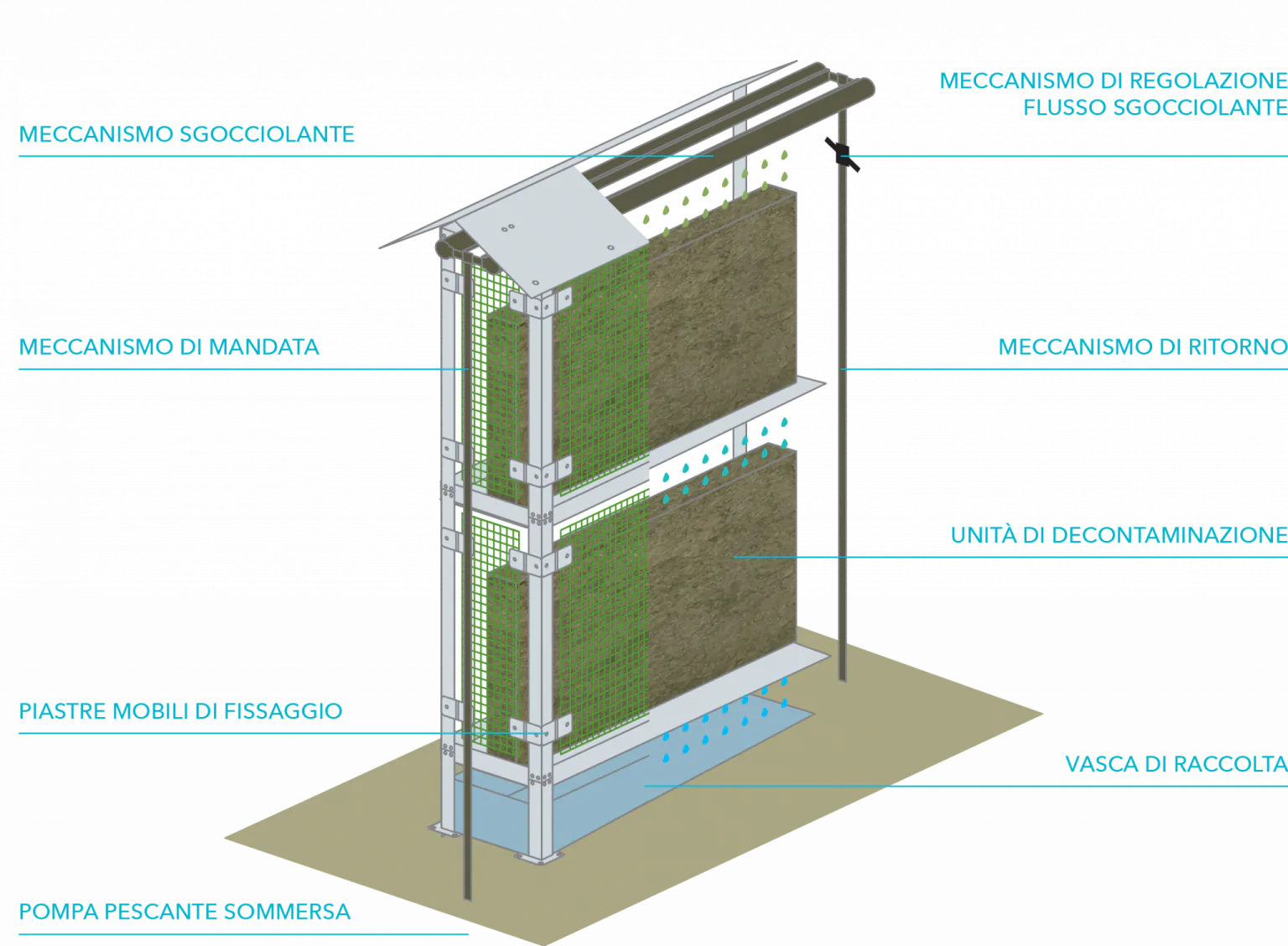 Fitoblock is equipped with the following certifications:
- functionality tests conducted with ITIS (Technical Industrial Institute Galileo Galilei of Arezzo);
- Fitoblock simplifies, from a functional and economic point of view, the operations of correct disposal of washing water from agricultural vehicles contaminated by pesticides, allowing the disposal of hazardous special waste generated in full compliance with the procedures indicated by the Legislative Decree 152/06 - Environmental Consolidated Law.
The structure of Fitoblock is composed as follows: pre-assembled unit:
- mobile fixing plates;
- decontamination unit;
- return mechanism;
- delivery mechanism;
- dripping flow regulation mechanism;
- blocks and dripping mechanism.
accessories at the company's expense
- submersible suction pump;
- collection tank;
- washing area.
In conclusion, Fitoblock is the ideal solution for the disposal of pesticides as it is:
- cost-effective: low purchase, management, and disposal costs;
- self-sufficient: the product is equipped with a closed circuit;
- compact: vertical operation ensures reduced bulk;
- simple: considerable ease of installation, transport, use, and management;
- durable: the structure is resistant and designed to last a long time;
- flexible: the modular system adapts to any need.
PSR call for agricultural enterprises
All Regions of Italy have included the system for reducing point-source pollution from pesticides in various agricultural contribution calls, which give the agricultural entrepreneur the opportunity to benefit from non-repayable amounts ranging from 40% to 80%. To find out how to qualify, simply contact your trade association or your agronomist. Below is an example of an open call:
PSR call for agricultural enterprises in Tuscany
In Tuscany, the Region has launched a call that provides for a non-repayable contribution of up to 40% of expenses for agricultural enterprises. The objective is to support professional agricultural entrepreneurs who wish to make investments, material or immaterial, in their companies to improve their performance for the benefit of sustainable agricultural production. Here are the subjects that can access the call:
- professional agricultural entrepreneurs registered, even provisionally, in the regional registry pursuant to regional law 45 of July 27, 2007 and regional regulation 49 of September 6, 2017;
- professional agricultural entrepreneurs recognized, even provisionally, under state law 7 March 2003 n. 38 from other Regions or Autonomous Provinces;
- individuals equated to professional agricultural entrepreneurs pursuant to art. 20 of regional law 45 of July 27, 2007.
Eligible interventions for accessing the PSR call
Let’s analyze specifically which interventions are eligible under the call.
1- Construction and/or renovation of buildings
Among the eligible interventions for accessing the call are the construction and/or renovation of company buildings aimed at plant production, livestock, and for the transformation and marketing of agricultural products. Specifically, the following are eligible:
- interventions for plant production, aimed at improving economic performance, which include fixed greenhouses, including the spaces necessary to install technical systems;
- interventions for livestock production, aimed at improving economic performance and the quality of production. The areas covered by the measure include stables and shelters for livestock (including service pens for structures), barns and silos, rooms for housing animals during breeding, and rooms for laboratories to analyze and detect organoleptic, qualitative, and hygiene-sanitary parameters;
- interventions for the transformation of agricultural products, aimed at improving economic performance and the quality of production. This includes rooms for the preservation and storage of primary agricultural products and those obtained through the transformation process; rooms for transforming primary agricultural products into agricultural products; rooms for packaging primary agricultural products and/or agricultural products obtained from the transformation process; rooms for laboratories to analyze and detect organoleptic, qualitative, and hygiene-sanitary parameters.
Also eligible for the call are interventions for the marketing of agricultural products, aimed at improving economic performance and the quality of production. This includes all rooms and so-called handling platforms intended for the marketing of primary agricultural products and/or products obtained through the transformation process.
2- Energy efficiency interventions
Great importance is given to energy efficiency interventions, to steer agriculture towards a more eco-sustainable path with a low impact on the surrounding environment. For this reason, the call includes all energy efficiency interventions aimed at reducing energy consumption through the insulation of company buildings and fixed greenhouses and the overall improvement of heating and cooling system efficiency.
3- Removal and disposal of coverings
The interventions for the removal and disposal of coverings and asbestos cement parts are eligible if carried out on company production buildings, indicated in subparagraph 1, and on all structures intended for the storage of machines and equipment used in cultivation and harvesting.
4- Construction and/or renovation of storage structures
All interventions aimed at constructing and/or renovating structures for the storage and treatment of solid and liquid waste from livestock are eligible for the call.
5- Construction and/or improvement of structures for the storage and treatment of recycled water
Included in the measure are interventions to construct and/or improve structures for the storage and treatment of recycled water. When referring to storage structures, it means reservoirs, tanks, and basins for the storage of recycled water. Wells are not included. Recycled water is considered to be rainwater or wastewater, possibly to be reused for company activities, except for irrigation purposes. Included interventions aim to improve functionality and efficiency of use, such as securing, reducing losses, and reshaping to improve water collection capacity. Among these systems are also those aimed at improving the quality of the water itself through potabilization or phytoremediation systems, or aimed at reducing point-source pollution. Furthermore, investments in networks for the supply and distribution of recycled/treatment water are also eligible. All investments are eligible only if intended for breeding and/or transformation and/or marketing activities. Investments intended, either exclusively or partially, for cultivation activities are excluded.
All other eligible interventions
To complete, here is the list of all other interventions eligible under the measure:
- land improvements for systems intended for the production of perennial plant species; for structural elements for pasture management; for hydraulic-agrarian arrangements; for fences to protect housed livestock; for fences to protect crops from wildlife damage;
- company equipment for the purchase and installation of machinery, systems, and equipment to carry out cultivation and harvesting operations, for the transformation and marketing of agricultural products, for agriculture, for precision livestock farming, and for breeding;
- for the installation of posters, billboards, and signs with the aim of informing and advertising under the provisions of Regulation (EU) No. 808/2014;
- intangible investments, such as websites and software programs;
- general expenses.
Facilitations and methods for submitting PSR applications
The support amounts to 40% of all investments, except for general expenses. Also keep in mind the following increases:
- 10% for investments made in mountainous areas pursuant to paragraph 1 letter a) of art. 32 of Regulation (EU) No. 1305/2013. This increase is recognized only if 95% of the UAA falls within the mountainous area;
- 10% for young farmers who must meet certain requirements. First of all, the age, which must not exceed 40 years at the time of submitting the aid application. The farmer must also have settled within the 5 years preceding the submission of the application. Finally, they must possess specific professional skills that must be demonstrated by holding the Iap qualification definitively, within the 5 years preceding the submission of the application.
Applications for aid with a minimum requested/granted contribution lower than 5,000 euros are not accepted. However, an advance of up to 50% of the eligible contribution can be received after the beneficiary submits the request. The advance is granted only after the start of the activity subject to the contribution and following the submission of a guarantee issued in favor of Artea. Applications can be submitted between May 9 and July 4, 2022. Applications are ordered in a list according to scores derived from selection criteria. -> Discover more - Fitoblock system for the disposal of water with pesticides<-