How attentive are you to respecting the environment?
There are tools to understand your impact on the environment
3 minutes of reading and you will have plenty of information to understand what your Water Footprint
Everything we do leaves a mark on the world. Whether it's the CO2 we release into the air by breathing, or the waste we generate every day, humans have a significant impact on the environment around us. We often hear about carbon footprint, ecological footprint, but a lesser-known term is water footprint, which is an indicator of the use (both direct and indirect) of freshwater by a consumer or producer. It identifies the total volume of freshwater used to produce goods and services. (source: Ministry of Environment and Protection of Land and Sea).The water footprint is measured in volume of water per unit of time. Let's look at some practical examples together: 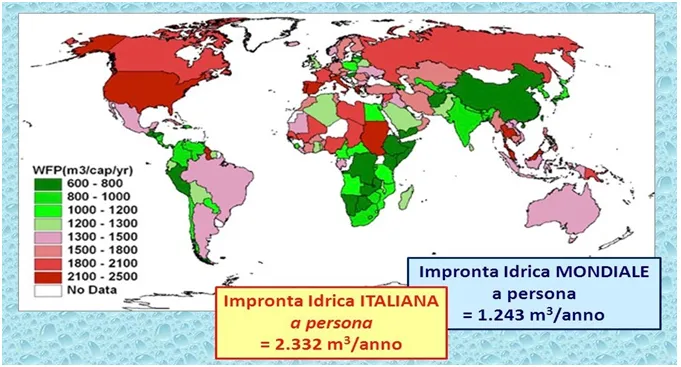
Image 1
The map above of water footprint in Italy (source: WWF water footprint - https://www.wwf.it/) provides clear indications on the per capita water consumption of each country. In red, the country with the highest per capita consumption, in green those with the lowest consumption. Unfortunately, Italy ranks among the countries with the highest consumption and consequently a high water footprint. According to an article in Focus magazine (https://www.focus.it/ambiente/ecologia/giornata-mondiale-dellacqua-limpronta-idrica-italiana), we find on Earth “1.4 billion cubic kilometers of water, but we can only use 0.0001% for our consumption.” The problem is not the amount available for our consumption but the fact that this water is not renewable, and therefore the amount of water available necessary for human survival will continue to decrease. 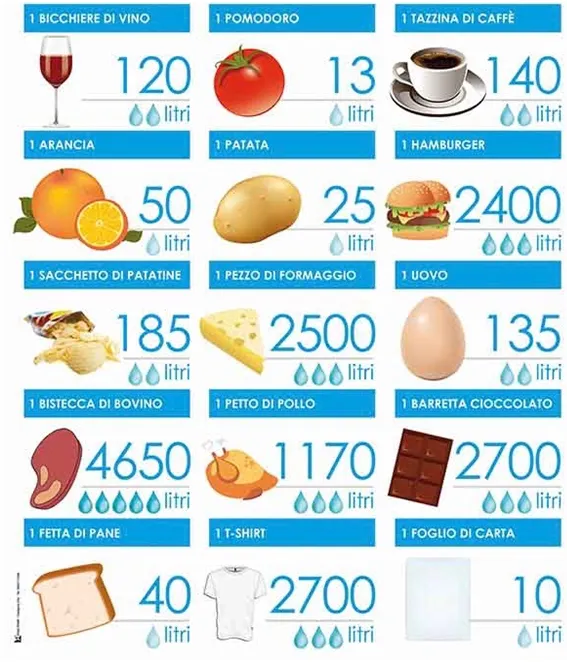
Image 2
In the image above (source: the water factory), you can see how much water is needed to produce one of the consumer goods listed. Clearly, the calculation of the water footprint of each good takes into account the entire life cycle of the product, from its design to the final stage. Do you want to know how to reduce your water footprint and that of your family? Below are 3 small gestures + 1 that, if done daily, create enormous results both for water and for your health:
- Consume local products – The production of gasoline needed to transport products requires a lot of water.
- Buy quality items/clothes – To use the example from image 2, if the water footprint of a t-shirt is 2700 liters, you could reduce your water footprint by buying quality products that last over time; which would prevent you from frequently buying new t-shirts.
- Consume less sugar or fewer sweet products – Growing sugarcane requires a large amount of water.
- Reuse treated wastewater – For irrigating the garden and green spaces of the house
These are just a few examples among many others to reduce our personal water consumption or water waste in your home.
Do you want to start with point 4? Contact us and we will help you do it.
Water footprint calculation:
Calculation method: generally, the water footprint is divided into 3 components (source: classification from the Ministry of Environment). WF= UWv+UWb+UWg 1-Green water (UWv): is the volume of rainwater that does not contribute to surface runoff and mainly refers to the water evapo-transpired for agricultural use. 2-Blue water (UWb): refers to the withdrawal of surface and groundwater intended for use for agricultural, domestic, and industrial purposes. 3-Grey water (UWg): represents the volume of polluted water, quantified as the volume of water necessary to dilute pollutants to the point that the chemical composition of the water returns above quality standards. Vince Lombardi, famous American football coach who won five championships and two consecutive Superbowls said: “The results of an organization are the results of the combined effort of each individual.” If each of us makes a small effort, we will all together be able to contribute to the safeguarding of the most precious resource on Earth.
Water footprint of food
The water footprint represents the total amount of water used to produce a good or service. In the food context, it assumes crucial importance, as food production is one of the largest consumers of water resources. Understanding the water footprint of food helps identify which products have a greater impact on global water resources and provides a basis for more sustainable consumption strategies. The variation in water footprint among different foods is significant: for example, meat production requires much higher amounts of water compared to those needed for growing vegetables.
Comparative Table of Water Footprint
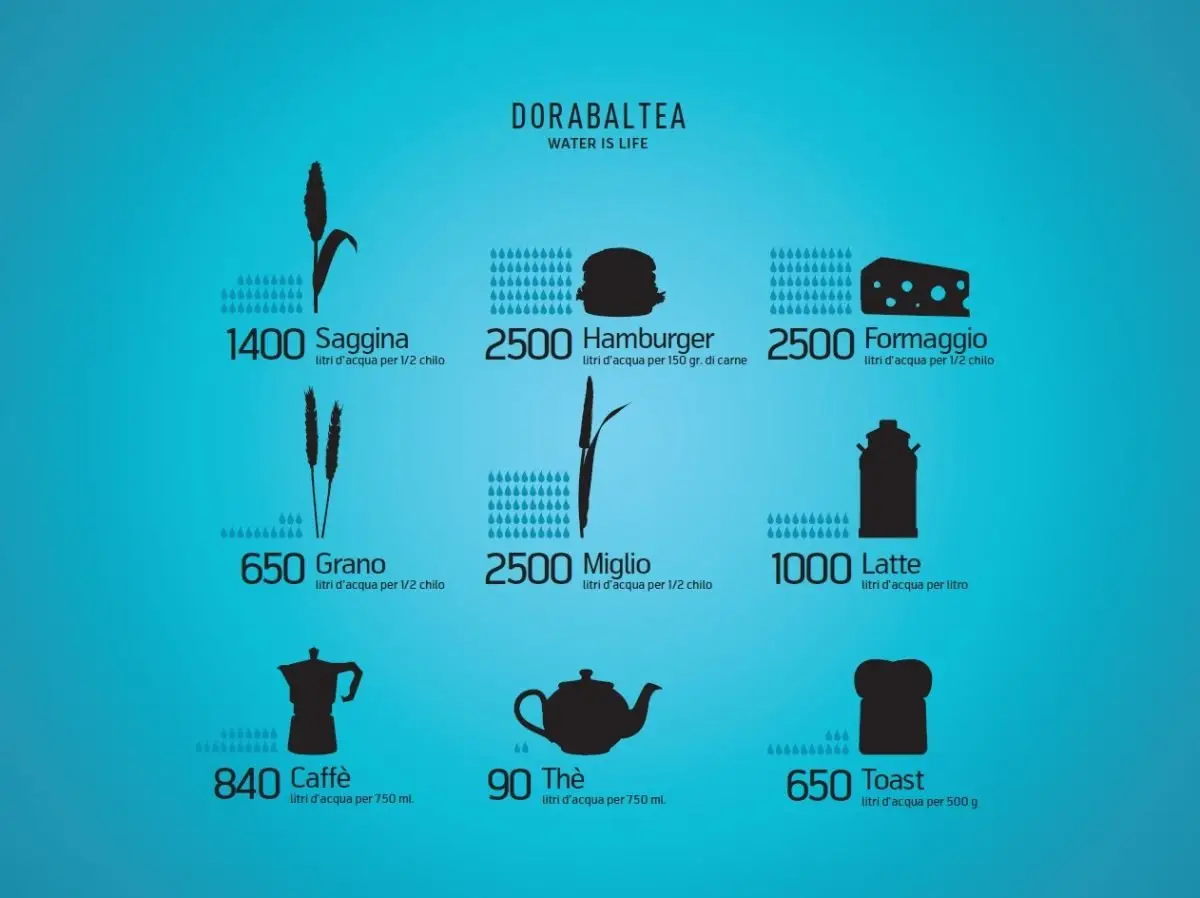
A comparative table of the water footprint of various foods reveals significant differences. Beef, for example, has a water footprint of about 15,415 liters/kg, while chicken is about 4,325 liters/kg. Plant products like tomatoes have a much lower water footprint, around 160 liters/kg for fresh tomatoes. These data highlight how the choice of food products can have a direct impact on the use of water resources.
Environmental Impact of Different Industrial Sectors
The livestock sector is among the largest consumers of water in the food field. Raising livestock not only requires large amounts of water for the animals but also for the cultivation of feed. In contrast, the agricultural sector, while being a large user of water, has a relatively lower impact per unit of product, especially in the case of sustainable agricultural practices. The dairy and beverage industry, although variable depending on the products, tends to have a considerable water footprint, particularly for products like cheese and milk-based beverages.
Strategies to Reduce Water Footprint
To reduce the water footprint in the food sector, consumers can make conscious choices, favoring products with a lower water impact and supporting sustainable production practices. Companies, on the other hand, can implement technologies for efficient water use and improve water resource management. Raising awareness on these issues is essential to promote change at the production and consumption levels.
The Importance of Wastewater Treatment Plants in Reduction Strategies
Wastewater treatment plants play a key role in reducing the water footprint, especially in the food industry. These systems allow for the recycling of water used in production processes, thus reducing the overall consumption of freshwater resources. The use of treatment plants is an increasingly common practice, through which it is possible not only to save water but also to reduce pollution, ensuring an overall lower environmental impact. The water footprint of food is a fundamental indicator for understanding and mitigating the environmental impact of the food sector. Through conscious choices and the adoption of technologies such as wastewater treatment plants, it is possible to embark on a path towards more sustainable production and consumption, thus benefiting the environment and the water resources of our planet.
Do you want to know how to reduce your water footprint?
Contact us now and we will be happy to help you