

The biological treatment of domestic wastewater MBBR by dorabaltea certified CE EN 12566-3 is a reliable and economical solution for installations where there is no possibility of connection to public sewers.
The biological treatment system MBBR is characterized by a single block within which the separation of coarse materials takes place first, followed by the biodegradation of the organic load; all phases of the domestic wastewater treatment process occur inside it, it does not require a biological tank installed upstream and is particularly suitable in situations with a single discharge column for grey and black water.
Being a completely underground treatment system, the tank is made of high-density polyethylene resistant to aggressive agents, while the corrugated design ensures mechanical resistance to stresses transmitted to the structure by the surrounding soil.
The MBBR system is technologically advanced and uses submerged bio-filter technology for pollutant removal, which guarantees high treatment efficiency while using reduced volumes, thus allowing for space savings and reduced excavation costs. The high treatment performance of the system allows for the discharge of treated water both underground through drainage and into surface waters, such as ditches, rivers, ponds, or lakes.
The natural biofilm treatment plant MBBR by dorabaltea complies with the parameters of appropriate plants indicated by D.Lgs 152/06 Environmental Code part III on Environmental Protection and is in accordance with all regional regulations.
Treatment Process – MBBR Technology (Mixed Bed Biofilm Reactor)
The MBBR wastewater treatment system consists of a sequence of phases that are set in the control unit at the time of installation and subsequently occur completely automatically.
The raw wastewater coming directly from the household without being refined by a biological tank is first introduced into the primary treatment chamber where the separation of coarser materials that settle at the bottom of the tank and lighter materials that float on the water surface occurs. Also in this purifying phase, which takes place in an anaerobic environment, i.e., in the presence of very low dissolved oxygen content in the water, the first reduction of nitrogen compounds occurs through the biological denitrification process whereby nitrites (NO2) and nitrates (NO3) are reduced by the bacterial load to nitrogen gas (N2), an odorless gas that thus returns to the atmosphere (nitrogen gas is the main component of the atmosphere, making up 73% of it).
Following the primary pre-treatment phase, the biological MBBR treatment plant by dorabaltea uses the latest technology of biomass adhered to a moving bed (MBBR) for the degradation of the organic pollutant component in domestic wastewater, utilizing microorganisms present in nature to activate this treatment process.
These biological reactors consist of tanks within which support elements for natural bacterial masses are kept in motion, made of plastic materials, whose specific weight is close to that of water, and on which a biological film (biofilm) develops.
The growth of this biofilm on the support is the result of the development processes of the bacteria present in nature that, adapting to the composition of the wastewater from modern households, feed on pollutants and biodegrade them, resulting in clean water at the outlet of the treatment plant that can be delivered to receiving bodies other than the public sewer.
The availability of "food" which for us is the pollutant, to the microorganisms adhered to the plastic supports is enabled by an air injection system or mixers, which allow for complete mixing of the wastewater and plastic supports, thus reducing the presence of hydraulically dead zones and maximizing the available volume.
Downstream of the biological reactor, further refinement of the water is carried out through secondary sedimentation, which serves to separate the suspended solids from the treated liquid, which in other technologies would instead be dragged out of the treatment plant and discharged into the environment.
Operating Description
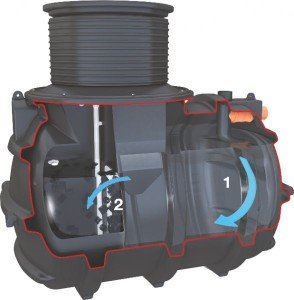
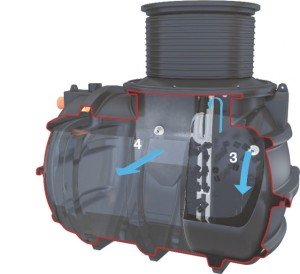
- PHASE I: the wastewater coming directly from the household drain is introduced into the first chamber of the MBBR treatment plant where the separation of heavy coarse material from light material occurs.
- PHASE II: the pre-treated wastewater is introduced into bio-zone number 1 of the MBBR biological reactor (Mixed Bed Biofilm Reactor). The biological treatment process and the mixing of the organic component present in the wastewater to be treated are activated by injecting air from below.
- PHASE III: for further treatment, the wastewater is introduced into bio-zone number 2 of the biological reactor with MBBR technology; this treatment phase that characterizes the dorabaltea MBBR plant is particularly important for the treatment of domestic wastewater from users with slight load discontinuities.
- PHASE IV: the wastewater exiting phase 3 is introduced into an additional secondary sedimentation tank. From here, the clarified water is discharged into the receiving water body while the settled sludge is naturally recirculated back into the first chamber without the need for electromechanical equipment.
Good Usage Practices
The MBBR moving bed biomass wastewater treatment plant allows for effective treatment even in smaller and dispersed users, avoiding the collection of low loads over long distances. The treatment efficiency is marked CE EN 12566-3:2009 and complies with R.Eu 305/11.
It is important to note that rainwater must not be discharged into the MBBR DB moving bed biomass treatment plant.
Fields of Application
The MBBR DB treatment plant can be used for scattered or remote users from the sewer network up to 6 equivalent inhabitants.
With the BIOPURA system, it is possible to treat:
- Domestic wastewater from all types of users
- Discharges from offices and small businesses.
- All other wastewater as long as it is of civil/domestic nature
CERTIFIED TREATMENT EFFICIENCY CE EN 12566-3 A+1:2009 :
| Parameter | Treatment Efficiency |
|---|---|
| COD | 90.6% |
| BOD5 | 94.4% |
| N-NH4 | 99.0% |
| SS | 92.7% |
| P | NPD |
| KN | NPD |
Regulatory References
The adhered biomass treatment plant falls under active sludge treatment systems and is therefore indicated as a secondary plant element by D.Lgs 152/06, and reported in various Regional regulations, to be used downstream of primary systems for sedimentation, necessary to reduce the pollutant load of wastewater to protect groundwater. The MBBR DB monoblock plant combines both sedimentation and oxidation phases in the same structure, thus reducing the space required for installation.
The plant is also compliant with R.EU 305/11, the European regulation regarding the technical standards for construction products.
IMPORTANT
The European Regulation No. 305/11 on Construction Products has stipulated that this type of plant must also be tested according to the technical standard EN 12566-3 for both structural and functional parameters, and the relevant results must be made available to anyone who requests them since July 1, 2013 through appropriate documentation.
Links:
- Legislative Decree 152/06
- R.EU 305/11
- Law 319 10/05/76
- Regional Protection Plans
Maintenance
As with other wastewater treatment systems, it is very important to maintain primary treatments such as septic tanks and grease traps if installed, carried out at appropriate intervals; in this case, the sedimentation tank is an integral part of the system, so it should be emptied in accordance with the instructions provided by the manufacturer.
Periodic maintenance operations must be carried out by vacuum truck companies that will then have to dispose of the waste at a landfill or public treatment plant.
More specific technical interventions should instead be carried out by specialized personnel.
Indicative List of Advantages
- High constant and lasting treatment efficiency confirmed by tests in accordance with CE EN 12566-3 + A1: 2009
- Fully automatic operation
- Easy, quick, and economical installation
- Low management costs compared to traditional civil/domestic wastewater treatment plants.
- Guaranteed tank for 25 years
- Monoblock system without the need to install a septic tank upstream
- Installable in driveable areas
- Absence of odors and noise
- No visual impact, the MBBR DB system is completely underground
- Burial level adjustable with special extensions to the lid
Indicative List of Disadvantages
- Not usable in the presence of users with high discontinuous use
- Not usable for recycling for irrigation use by nebulization
- In the presence of old tanks, these must be bypassed or replaced with the system itself