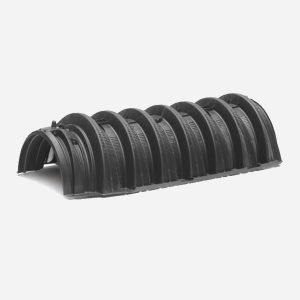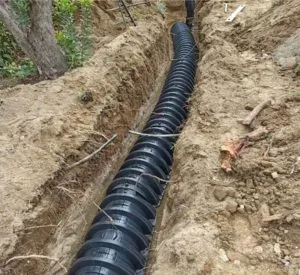
The drainage trench/subirrigation (also called drainage pipe for biological pit) is a system designed to disperse rainwater (for example, that of second rain) or for the appropriate treatment of treated wastewater in the absence of a sewer network and/or receiving body (rivers or ditches).
For the treatment of wastewater, it operates through drainage into the ground and the development of natural biological self-purification phenomena; in fact, the bacteria present in the soil feed on the organic part contained in the effluent, and the waste from this digestion is no longer polluting for the environment.
As an alternative to a “comb” of subirrigation, a dispersing tray can also be used as a dispersion system.
The balance of the wastewater treatment system, called subirrigation, is very delicate and is no longer very suitable for treating wastewater from modern homes where the organic load is now only a minimal part of the total.
Its purification efficiency can be increased by using partially impermeabilized phyto-assisted subirrigation.
Upstream of the drainage trench, according to Legislative Decree 152/06, Environmental Code, Part III on environmental protection, it is mandatory to install primary treatment systems such as an Imhoff pit, septic/biological pit, grease trap, as well as secondary treatment systems such as activated sludge treatment plants, percolating filter treatment plants, and other secondary treatment plants deemed appropriate by law.
Traditionally, drainage trenches are excavations capable of disposing of water from/in the surrounding soils, filled with natural inert materials (gravel or quarry rubble) with high permeability.
To prevent clogging of the drainage body, it is completely covered with layers of non-woven fabric.
Furthermore, the need for abundant space does not allow its use for all users.
Good Usage Practices
Subirrigation, like all treatment systems suitable for the disposal of domestic and/or assimilated wastewater, must be installed at a minimum distance of 30 m from private wells and 200 m from public wells, and a geological report must be carried out in advance to verify the drainage suitability of the soil where the intervention will take place.
If it is impossible to maintain such distances and thus the discharge is not authorized, it is possible to consider the evapotranspiration system, which uses the operational criteria of phytodepuration but with different sizing criteria, and if well designed, maintained, and managed, does not produce discharge of polluted wastewater.
In agricultural areas, it is important not to have crops within a radius of at least 10/15 m from the installation area of the effluent disposal system.
The sizing of the drainage trench must be calculated based on the equivalent inhabitants that will use it and the drainage coefficient of the soil.
Between 3 (three) and 10 (ten) linear meters per equivalent inhabitant is the measure for the extension of the micro-perforated pipe to be buried for subirrigation.
It is noted that in the case of a system used for the disposal of wastewater, rainwater must absolutely not reach the drainage trench.
Fields of Application
Subirrigation can be useful in users far from the sewer system of small and medium size, up to a maximum of 100 equivalent inhabitants.
It can be a very suitable system for treating wastewater outside the sewer system, particularly in second homes, residences intended for permanent living with ample outdoor space available, in agricultural companies with a predominance of organic discharge, as well as for small users assimilated to domestic ones, such as refreshment points, very limited agritourisms, and all interventions assimilated to domestic ones with very limited non-organic pollutant quantities.
Regulatory References
Legislative Decree 152/06 (link to the legal text) defines it as an appropriate system to be used in conjunction with other necessary systems to reduce the pollutant load of wastewater and to return it to the environment as purified as possible.
According to Regional Regulation 46/r of the Tuscany Region, it can be used as an appropriate treatment following primary treatments for up to 100 equivalent inhabitants for the disposal of domestic and/or assimilated wastewater.
Link:
- Legislative Decree 152/06
- Resolution 04/02/77
- Regional protection plans
Maintenance
The maintenance of these systems is practically none as the burial does not allow access. There is only the possibility of intervening in the primary and possibly secondary treatments installed. Furthermore, poor functioning of the pre-treatment system can cause anomalies in the possible subirrigation system or dispersion system.
Periodic maintenance operations must be carried out by vacuum truck companies that will then have to dispose of the waste either at the landfill or at the public treatment plant.
Indicative List of Advantages
- good functionality even for load discontinuities
- cost-effectiveness of material purchase
- simplicity of installation possible even by non-specialized companies
- completely buried installation
- no use of electricity
- very low operating costs
Indicative List of Disadvantages
- not excellent purification yields
- high installation costs
- additional costs for necessary geological reports
- impossibility of installations in poorly draining soils or with a high water table
- possibility of soil swampiness due to poor drainage
- high operating costs due to the need for constant electricity for aerobic percolators that operate on electricity
- management and maintenance operations to be carried out by specialized personnel
- high environmental costs
You may also be interested in:
DRAINAGE SYSTEM IN THE SUB-SURFACE LAYERS OF THE SOIL FOR TREATED WASTEWATER